Preparing your view
MbwasiLet’s talk
Software engineering / graphic design
Software.Graphics.Products.

Hi, my name is Harry Mbwasi, a software engineering student at the University of Dodoma (UDOM), I build real solutions as a developer and a graphic designer at Techpreneurs Solution.
My value
Solving social problems digitally.
I have prior experience in Python through Django and Tkinter / CustomTkinter frameworks, making Unity multiplayer games, and using Java and Kotlin for Android mobile app development.
Software
I have made many projects that shape me towards making professional and impactful software, while ensuring that digital products are secure and well protected to avoid data from getting stolen or being altered.
Graphic design
Posters, banners, brochures, magazines, calendars and flyers. I also deal with making 2D digital art panels for use as wallpapers or printed portraits.
- Studying
- BSc Software Engineering
Second year, University of Dodoma - Working
- Developer and graphic designer
Techpreneurs Solution - Based in
- Dodoma, Tanzania
- Tools
- Python / Django / Tkinter / CustomTkinter / Java / Kotlin / Android / C# / C++ / Unity / Adobe Photoshop / Adobe Illustrator / Adobe InDesign / CorelDRAW
Project Gallery
Ventiqa
Digital invitations, live RSVP tracking and QR check-in for Tanzanian events. A Django platform, live at ventiqa.co.tz.Mineral tracker
A Django system for mineral stock and transport, built around four roles that each see a different slice of the same data.- Date
- January 2026
- Role
- Engineering
- Built with
- Django, Python, PostgreSQL, django-allauth
A management system for mineral stock and its movement, what is held, what is moving, and who signed for it.
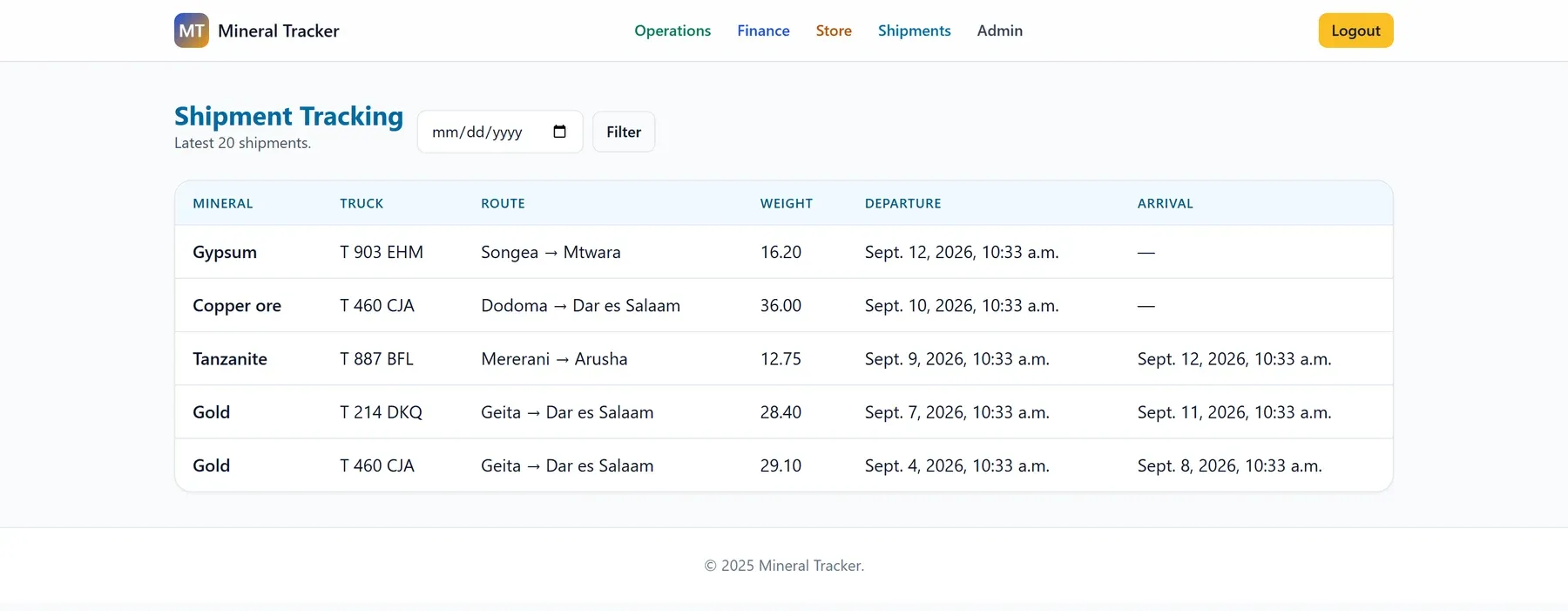
The records in these screenshots are sample data, entered to exercise the dashboards. They are not real trading figures.
Roles are the design
The system defines four roles, administrator, operations manager, financial manager and store keeper, and they are the organising idea rather than a permissions afterthought. Each role opens onto a different part of the same records, which is what separates a tool that a warehouse actually uses from a CRUD interface with everything visible to everyone.
Login is required everywhere: there is no page that shows a record to someone who has not signed in, and no route that quietly leaks one.
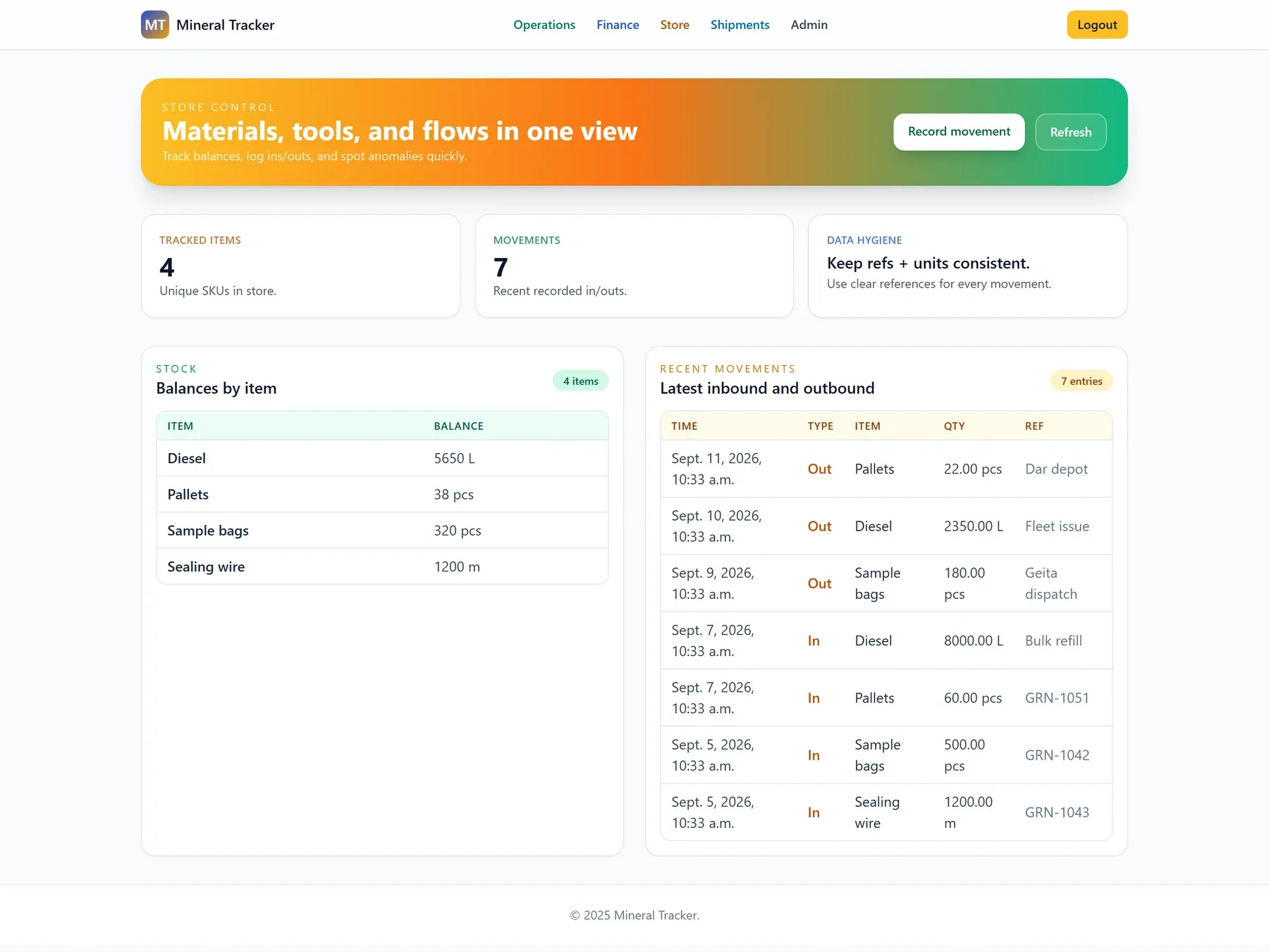
What that separation looks like in practice: the financial manager opens onto money, and the store keeper opens onto stock. Neither screen is a filtered version of the other.
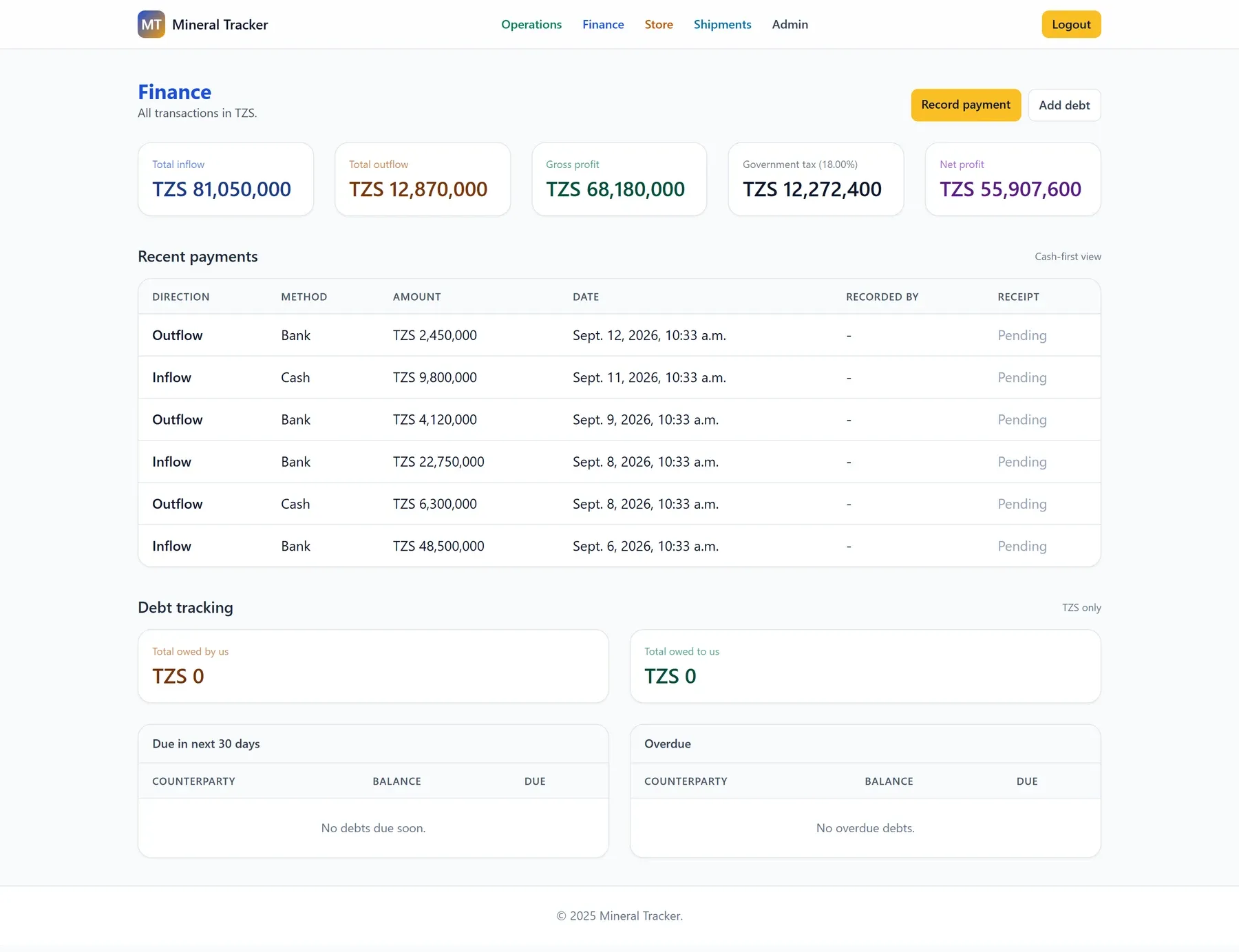
Tax is computed rather than typed: the rate is a setting, and the dashboard derives government tax and net profit from the inflows and outflows already recorded, so the figure cannot drift from the payments it is drawn from.
ScamShield
An Android app that watches incoming texts for scam patterns and walks Tanzanian users through reporting them to the TCRA.- Date
- September 2026
- Role
- Engineering
- Built with
- Android, Java, Gradle
Scam texts are a daily tax on people with phones in Tanzania. Reporting one means going to the Tanzania Communications Regulatory Authority on short code 15040, which is not something most people have to hand when a message arrives. ScamShield watches incoming SMS, flags what looks like a scam, and carries the user through reporting it.
The app brings message checking, a local history and reporting into one place. Automatic reading, sharing, pasting, screenshots and manual entry give users several ways to check the same kind of message.
Getting a message in
The decision worth pointing at is that there is no single way to submit a message. The analyse screen offers five, because the way a scam text reaches someone is not consistent:
- Read SMS automatically once the permission is granted, so incoming messages are scanned without being handed over.
- Share straight from Messages or any other app.
- Paste the text.
- Screenshot (OCR), extracting the text from an image. The case that matters when someone forwards a picture of a message rather than the message.
- Manual input, typing it out.
From the user’s side those are one feature. Underneath they are five quite different paths, and building all of them is a judgement about how people actually receive the thing you are asking them to check.
What it claims, and where it runs
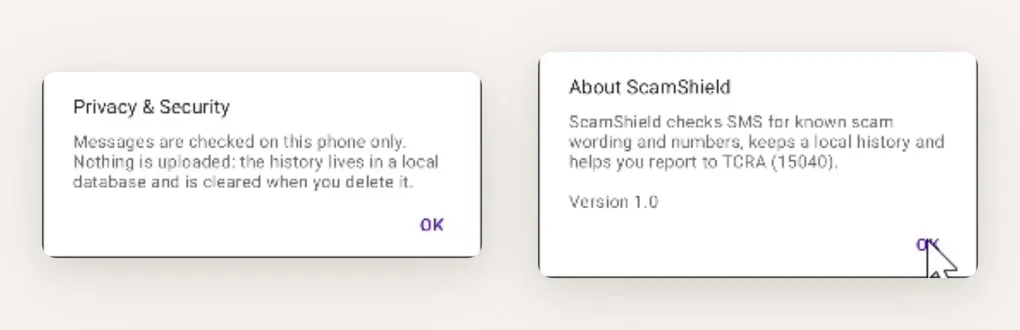
Two screens do most of the honest work. The privacy notice says messages are checked on the phone only, nothing is uploaded, and the local history is cleared when the app is deleted. The about dialog says plainly what the detection is: it checks messages for known scam wording and numbers. Not a model, not a service, a pattern match running locally.
That is the right shape for this problem. An app that asks to read every text you receive and then sends them somewhere is a worse deal than the scams it protects against, and putting that on a screen the user can actually find beats putting it in a privacy policy.
History, and what the user controls
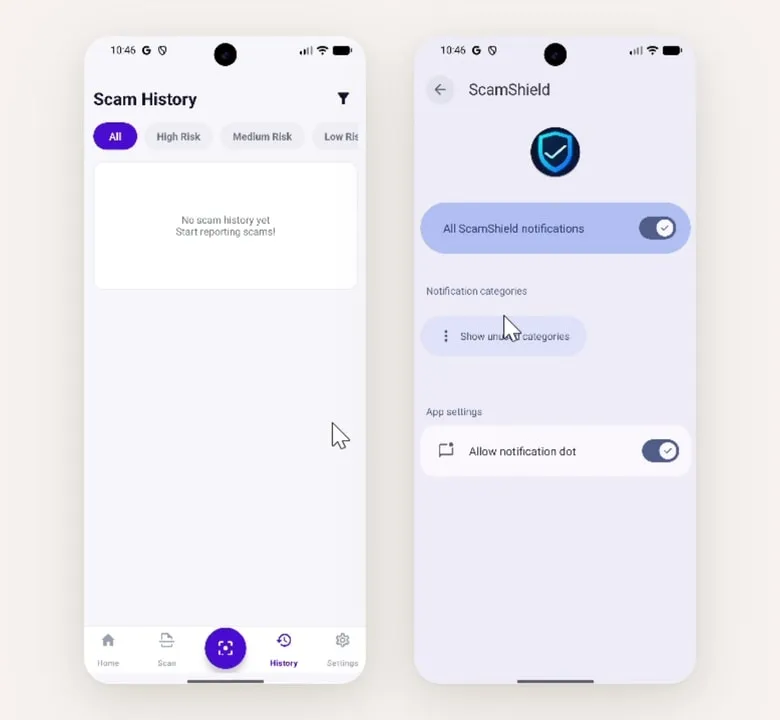
History filters by risk level, and its empty state reads “No scam history yet, start reporting scams!” rather than “No data”. On the right is Android’s own notification settings, and what it shows is the app’s doing: ScamShield declares separate notification channels rather than one, so someone who wants scam alerts but not everything else can have exactly that. Neither is hard; both are the kind of thing that usually gets skipped.
Screens captured from the app walkthrough.
The Outbreak
A hidden-role LAN game in Unity. Roles are dealt in secret, and the bunker they are dealt in is generated by code, not hand-built.
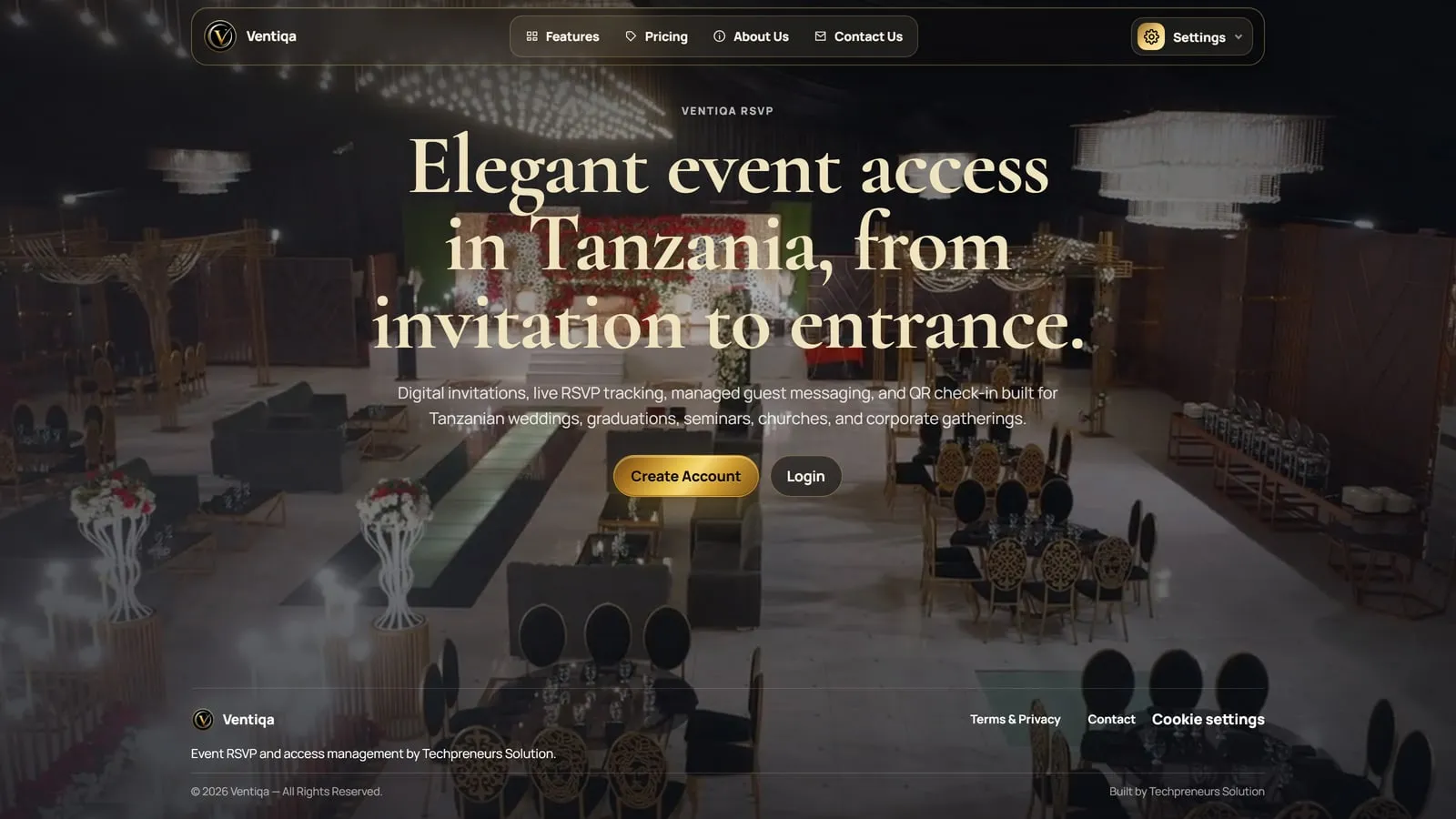
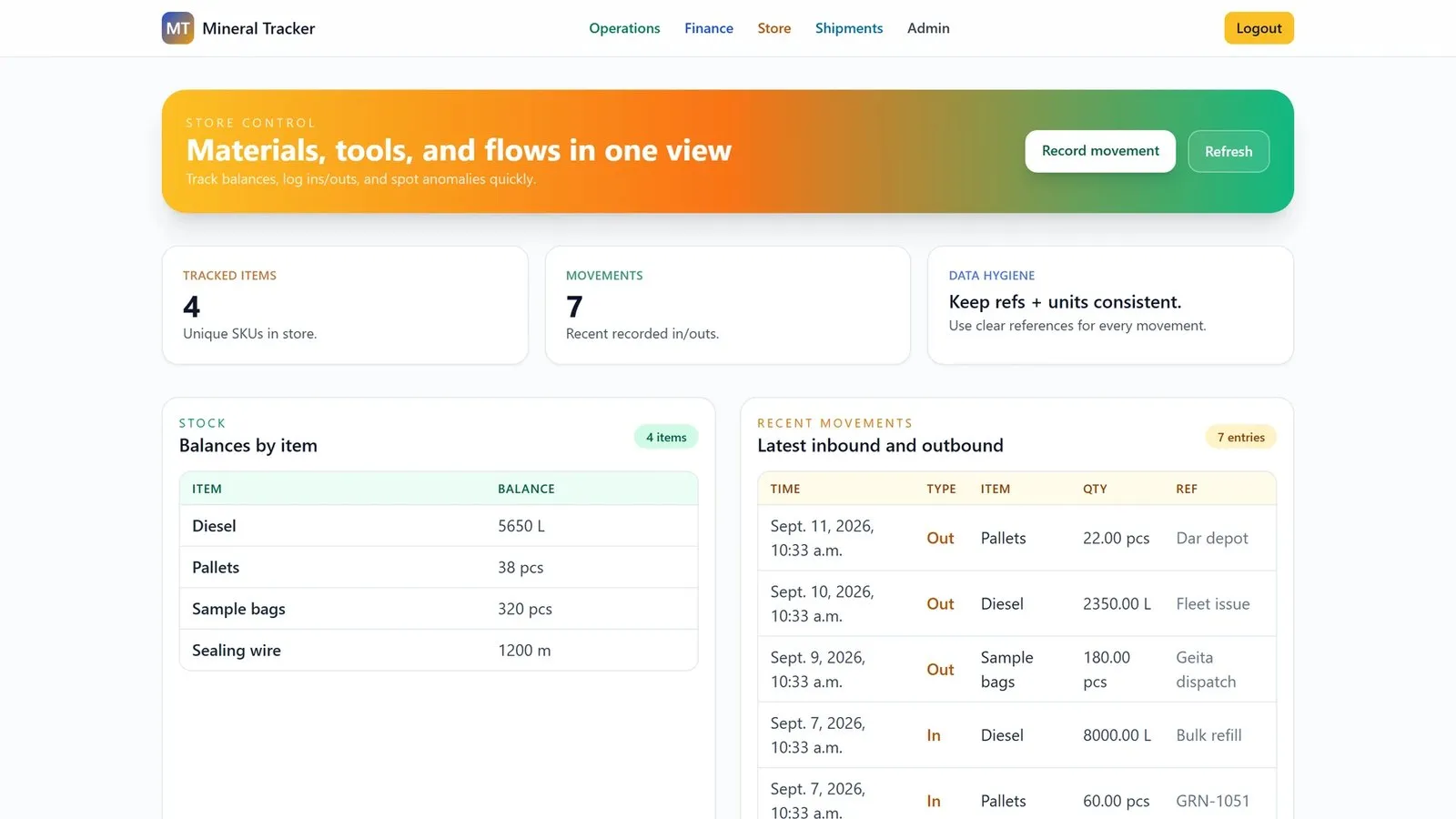
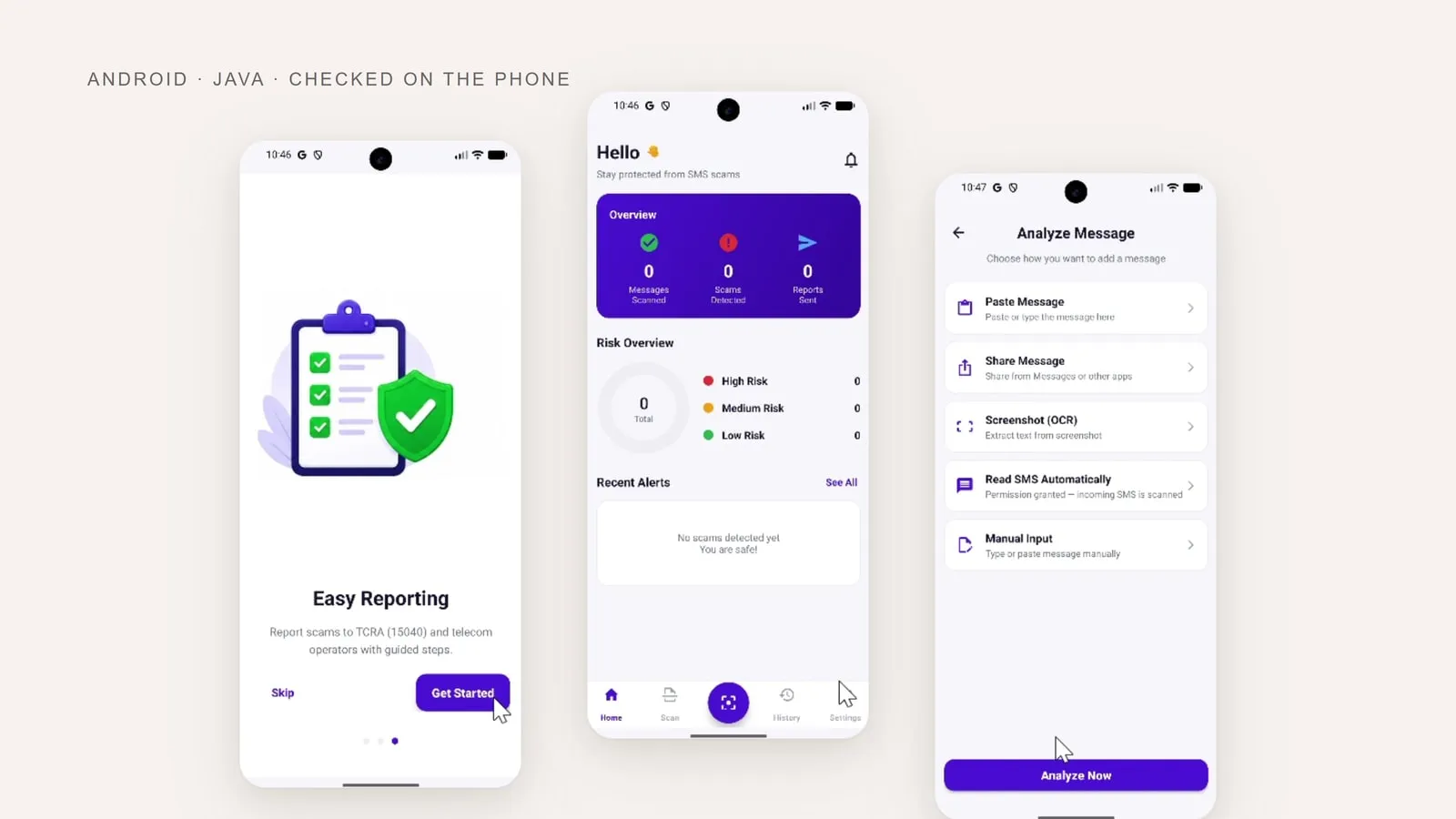
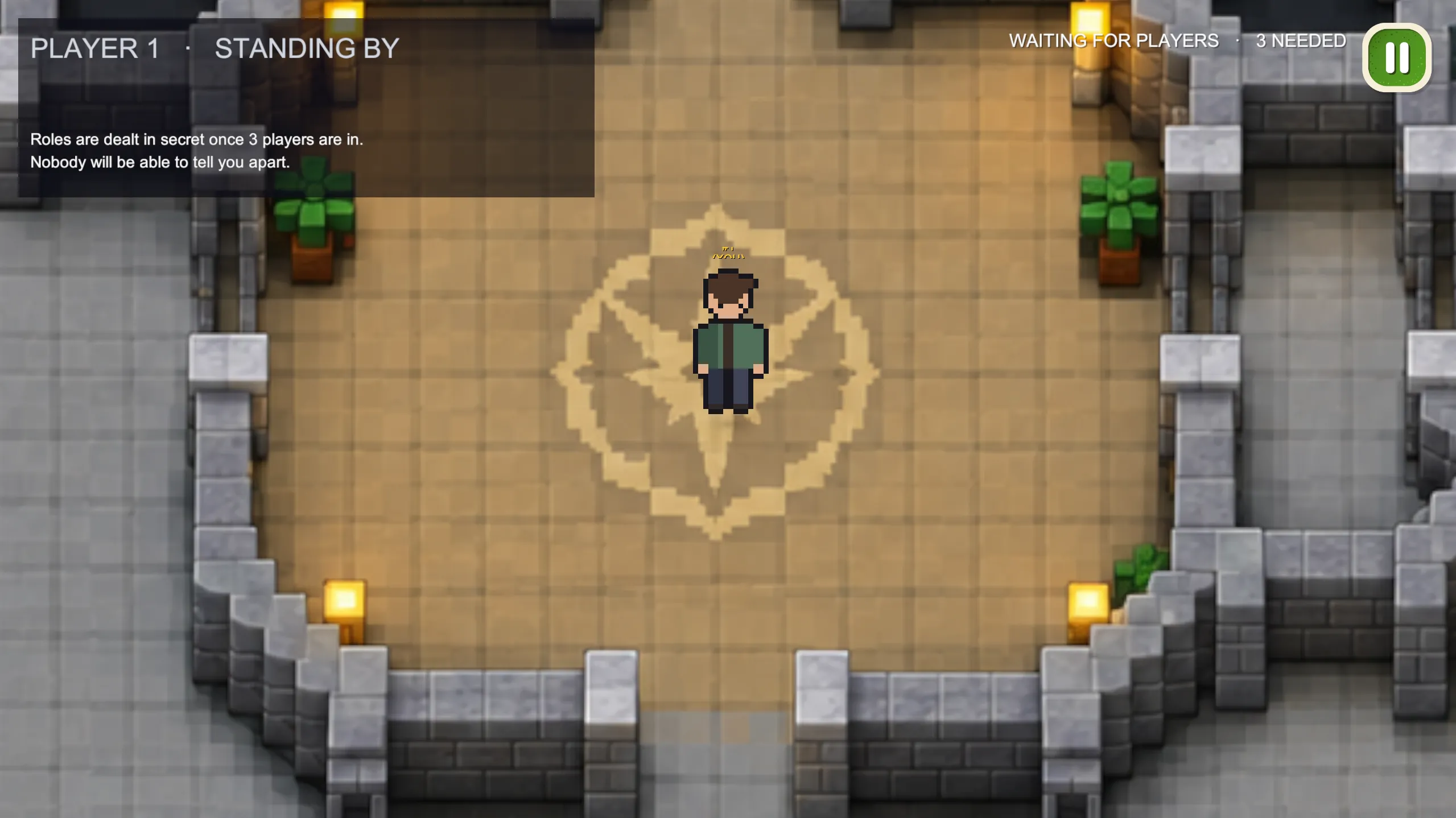
Photo composites
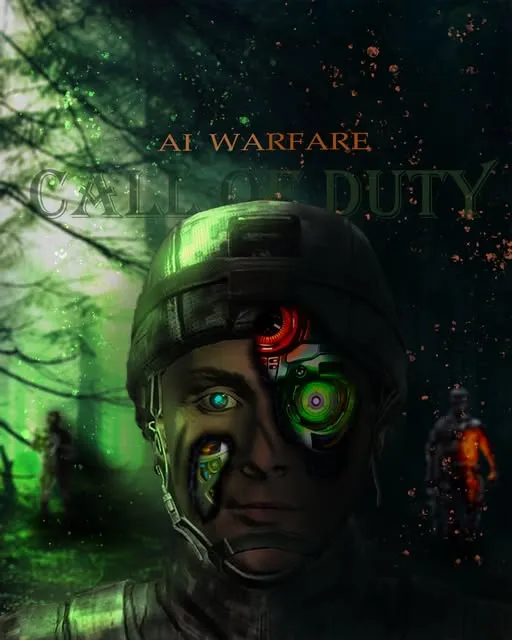
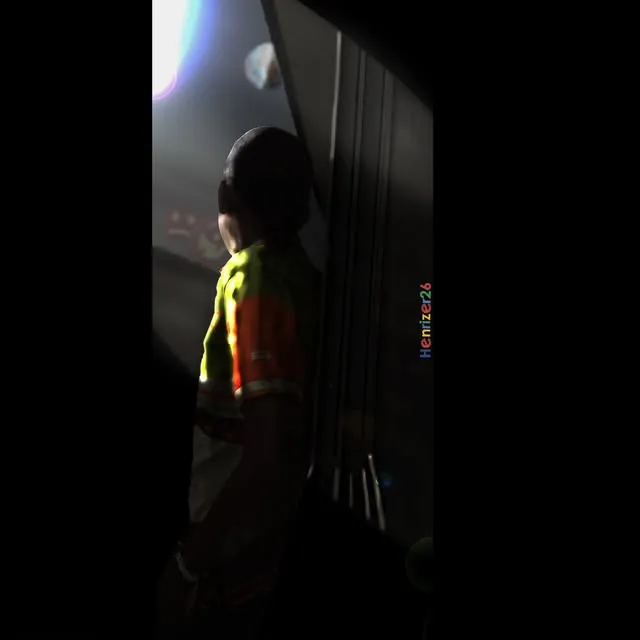
One image at a time.
Photographs blended in Photoshop into surreal, cinematic scenes. Use the arrows to move through the work.





My profiles
Where to find me.
Code on GitHub, artwork on Instagram, and the rest in between.
Build


Make

Talk


Community
Email[email protected]